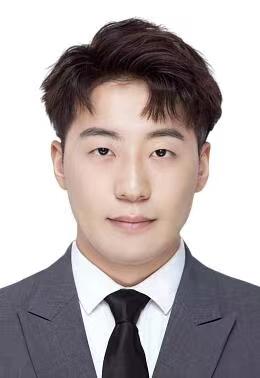
🧍♂️ About Me
Hangbei Cheng (成航北)
Master’s Student (Class of 2023)
College of Computer Science and Technology, Taiyuan University of Technology (TYUT)
Advisor: Assoc. Prof. Yongfei Wu and Assoc. Prof. Xueyu Liu
Lab: IMBR Lab @ TYUT
“愿专注视觉理解,做真正看得懂世界的模型,也做值得被记住的成果。”
📫 Contact: chenghangbei0702@163.com
🔗 Links: GitHub
🔍 Research Interests
My current research focuses on vision modeling and learning with limited annotations in medical image scenarios. Specifically:
-
Weakly Supervised & Semi-supervised Medical Image Segmentation
→ Multi-scale lesion feature learning, label noise robustness, shape prior modeling. -
Multi-modal Prompt Engineering & Visual Foundation Models
→ Leveraging large-scale models (e.g., CLIP, SAM) for domain adaptation, semantic alignment, and efficient transfer to medical domains. -
Embodied Intelligence & Multi-agent Collaboration in Medical AI (Exploratory)
→ Modeling decision-making and robustness in multi-agent, multi-modal diagnostic systems.
My long-term vision is to design intelligent, trustworthy, and interpretable visual systems that can truly “see and understand” the world, not just recognize pixels.
🎓 Education
- 2019.09 – 2023.07 — B.Eng. in Data Science and Big Data Technology, College of Big Data, TYUT.
- 2023.09 – Present — M.Eng. in Computer Science and Technology, College of CCST, TYUT.
📝 Publications
✍️ Representative Papers
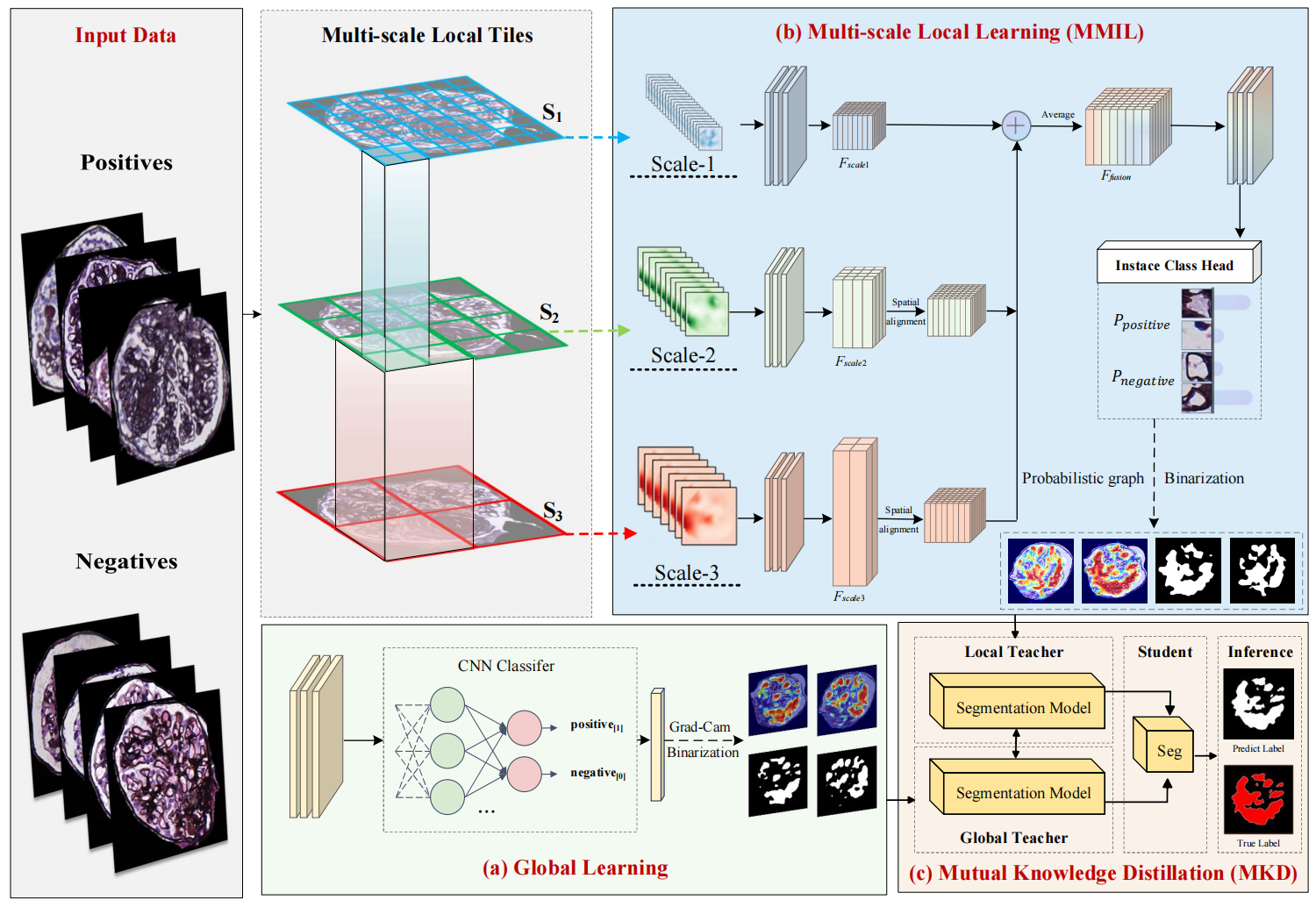
- First Author. GLMKD: Joint Global and Local Mutual Knowledge Distillation for Weakly Supervised Lesion Segmentation in Histopathology Images.
Expert Systems with Applications (SCI-Q1 TOP, IF=7.5) Published
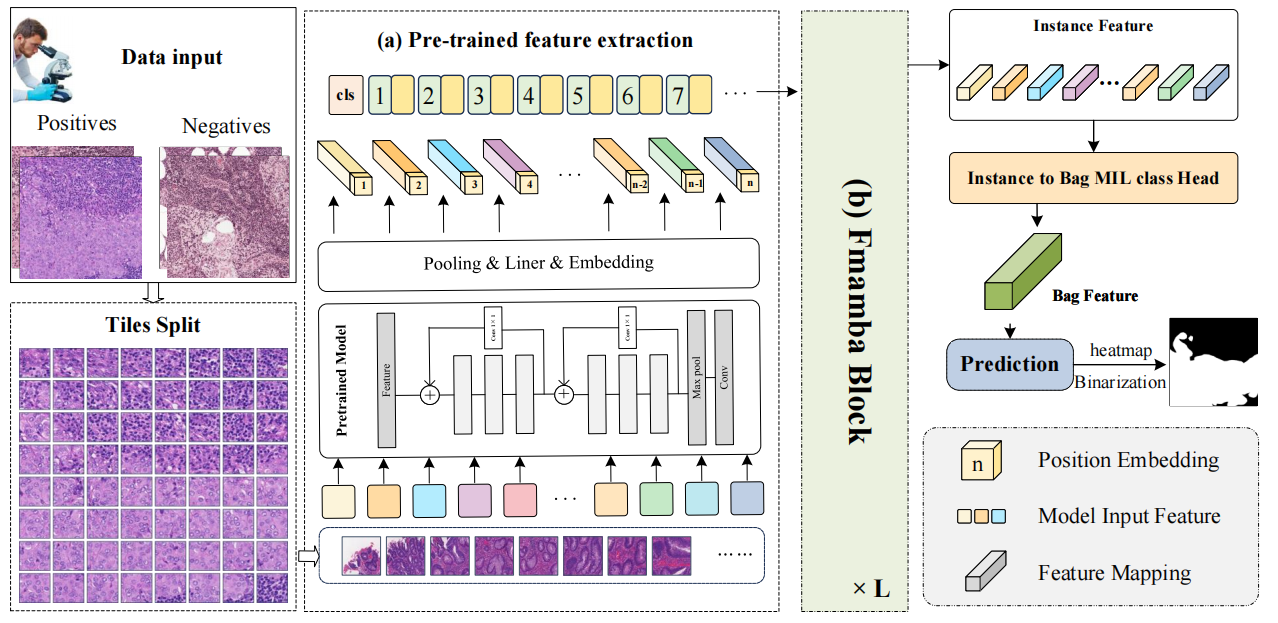
- First Author. FMaMIL:FFT-enhanced Vision Mamba Multi-instance Learning for Weakly Supervised Lesion Segmentation in Medical Images. Medical Image Analysis (SCI-Q1 TOP | CCF-B, IF=10.7) 1st RRC
| arXiv Paper | Code |
Highlights:
- Introduced the first Mamba-based MIL segmentation model with learnable frequency encoding.
- Bidirectional scanning captures contextual pathology structures.
- CAM-guided soft label correction boosts robustness to label noise.
📚 Other Publications
🔬 Medical Imaging
-
First Author. SegMind: Dual-Brain Collaboration with Multi-Modal Prompts and Multi-Teacher Knowledge Integration for Semi-Supervised Medical Segmentation. AAAI 2026 (CCF-A) Submitted
-
First Author. FALMIL: Frequency-aware Linear MIL for Efficient Weakly Supervised Lesion Segmentation in Gigapixel Pathology Images. PRCV 2025 (CCF-C) Submitted
-
Co-First Author. DSAGL: Dual-Stream Attention-Guided Learning for Weakly Supervised Whole Slide Image Classification. Biomedical Signal Processing and Control (BSPC) (SCI-Q2) 1st RRC
-
Second Author. A Dual-branch Network with Cross-scale Feature Interaction and Alignment for WSIs Classification. Information Fusion (SCI-Q1 TOP, IF=15.5) 1st UR
-
Second Author. Multi-stained Renal Histopathology Image Segmentation via Meta-learning with Guided Collaborative Distillation. AAAI 2026 (CCF-A) Submitted
-
Second Author. DGMCN: Depth-Guided Multi-modal Collaboration Network for Robust Polyp Segmentation in Endoscopic Images. JVCIR (SCI-Q4) 1st UR
-
Third Author. LEPG-SAM: Local Enhancement Perception and Guidance for Weakly Supervised Medical Image Segmentation. To be submitted CMPB (SCI-Q2) Manuscript in Preparation
-
Co-author. Fourier Transform-Based Shape Constrained Framework for Generalizable Medical Image Segmentation. PRCV 2025 (CCF-C) Submitted
-
Co-author. MSMTSeg: Multi-Stained Multi-Tissue Segmentation of Kidney Histology Images via Generative Self Supervised Meta Learning Framework. IEEE JBHI (SCI-Q2 TOP) Published
-
Co-author. Diagnosis of diabetic kidney disease in whole slide images via AI-driven quantification of pathological indicators. CIBM (SCI-Q2) Published
🤖 Multimodal Learning, Federated Security & Embodied AI
-
Co-First Author. AlignBreaker: Multimodal Feature Perturbation Attacks on Embodied AI via Alignment Disruption. To be submitted usenix (CCF-A) Manuscript in Preparation
-
Third Author. MTSec: AIGC-Enhanced Security Model Training for Multimodal Federated Learning. Knowledge-Based Systems (SCI-Q1 TOP, IF=7.2) 2nd RRC
-
Third Author. Face Anti-Spoofing Model with Online Distillation of Local and Global Features. ACM MM 2025 (CCF-A) Planned Resubmission
💬 Research Projects
-
[PI] Multi-domain Visual Feature Fusion for Weakly Supervised Pathology Segmentation.
Shanxi Graduate Innovation Project (2024KY232), 09/2024–Present
→ Designed a dual-stream framework based on Mamba encoder to enhance spatial-frequency modeling for multi-scale lesion detection. -
[Core Member] High-resolution Kidney Pathology AI Diagnosis System.
Shanxi Natural Science Project(General Project), 09/2023–Present
→ Led MIL model development for lesion segmentation and KW-node recognition with interpretability constraints. -
[Team Lead] Auxiliary Diagnosis System for Kidney Pathology via Missing-Modality Generation.
National Innovation Training Program for College Students, 06/2025–Present → Developed stain transfer pipeline with meta-learning for style consistency and domain generalization.
-
[Team Lead] GAN-based Pathology Stain Quality Enhancement and Evaluation.
Shanxi Undergraduate Innovation Project, 06/2022–06/2023
→ Developed stain transfer pipeline with meta-learning for style consistency and domain generalization.
🎖 Honors & Awards
- 🏅 2023.06 — Outstanding Undergraduate Graduate, TYUT
- 🏅 2023.07 — Outstanding Undergraduate Thesis, TYUT
- 🏅 2022.05 — “May Fourth” Outstanding Communist Youth League Member, TYUT
- 🏅 2021.09 — Excellent Practical Team Member, TYUT
- 🏅 2021-2024 — “Internet+” / “Challenge Cup” Innovation Contests — *5× Shanxi Gold, 2× Shanxi Silver
- 🏅 2022.06 — 12th National “ZhengDa Cup” Market Research Competition — *3rd Prize
- 🏅 2023.06-present — National Scholarship ×1 (Postgrad), 1st-Class Postgrad Scholarship ×2
- 🏅 2019.06-2023.06 — 1st-Class Undergrad Scholarship ×6, National Encouragement Scholarship ×3
🧑🎓 Student Leadership & Activities
- 2021.06 – 2023.06 — Head, University Science and Technology Association, TYUT
- 2021.09 – 2023.06 — TYUT RuinoYun Innovation Base Student Leader
- 2022.09 – 2023.06 — Committee Member, Undergraduate Party Branch, College of Big Data
🧭 PhD Motivation & Direction
During my master’s, I’ve built a strong foundation in medical image modeling, weakly-supervised learning, and large vision model tuning. I aim to further explore explainable, robust and adaptive vision systems for complex real-world environments.
In the PhD phase, I hope to:
- Delve into multimodal and embodied perception
- Address trustworthiness and generalization in medical AI
- Bridge model-level innovation and real-world application
I’m open to collaboration or joint projects with labs on related topics.